
Choosing the right early learning environment for a toddler is one of the most significant decisions a growing family will make. For expectant parents and families with young children across our communities, looking for early education is no longer just about finding a safe place for supervision while parents are at work. Modern neuroscientific research reveals that a child’s brain forms more than one million new neural connections every single second during the first five years of life, making this period the absolute peak window for human cognitive development. Because of this rapid neurological growth, contemporary early childhood services have evolved from basic minded centers into highly sophisticated, research-backed educational environments. Selecting verified, high-performing child care services in Australia provides local families with a positive and structured foundation for unlocking their child’s full cognitive, social, and emotional potential. This organized approach to early education ensures that everyday interactions are intentionally engineered to stimulate critical thinking, build emotional resilience, and establish a joyful, lifelong relationship with learning well before the official transition into formal schooling.
The true value of modern early childhood education is anchored in the strict operational and educational standards governing the local landscape. Rather than relying on rigid, outdated instructional methods or unstructured, unguided supervision, high-quality centers utilize a national system designed to elevate the standard of care across the country. This system provides a robust blueprint that ensures centers focus deeply on child-led exploration, advanced behavioral support, and specialized learning frameworks tailored to individual developmental milestones.
The National Quality Framework: Elevating the Standards of Care
To understand how premium early learning services separate themselves from basic supervision, parents must understand the structure of the National Quality Framework (NQF). This rigorous national standard ensures high-quality outcomes across all early childhood education and care services by evaluating centers across seven critical quality areas, including educational program design, physical environment safety, and staff leadership.
Under the guidance of the NQF, certified educators implement the Early Years Learning Framework (EYLF), which prioritizes three main ideas: Belonging, Being, and Becoming. This framework prompts teachers to design fluid, responsive curricula that adapt to the changing interests and natural curiosity of each child. Furthermore, the national framework strictly regulates educator-to-child ratios, ensuring that toddlers receive high levels of individualized attention, emotional mirroring, and personalized language stimulation from qualified professionals during their critical formative years.
Engineering the Environment: What to Spot During a Center Tour
When families step into an early learning center for an initial tour, the physical layout of the rooms and outdoor spaces provides immediate clues regarding the quality of the educational philosophy. High-quality centers move away from sterile, school-style rows of desks or rooms overcrowded with flashy, overstimulating plastic toys.
Instead, premium learning spaces prioritize natural, open-ended environments designed to inspire child-led exploration and collaborative discovery. Parents should look for dedicated learning zones, such as loose-parts construction areas, quiet reading nooks, scientific discovery tables, and sensory mud kitchens outdoors. These purposefully arranged environments encourage toddlers to make independent choices, test hypotheses, and solve complex problems alongside their peers. Additionally, the presence of meaningful, child-authored artwork displayed at eye level shows a deep cultural respect for the child’s voice and creative identity, signaling a space where children feel completely safe to experiment and learn.
Play-Based Literacy and Numeracy: The Science of Guided Discovery
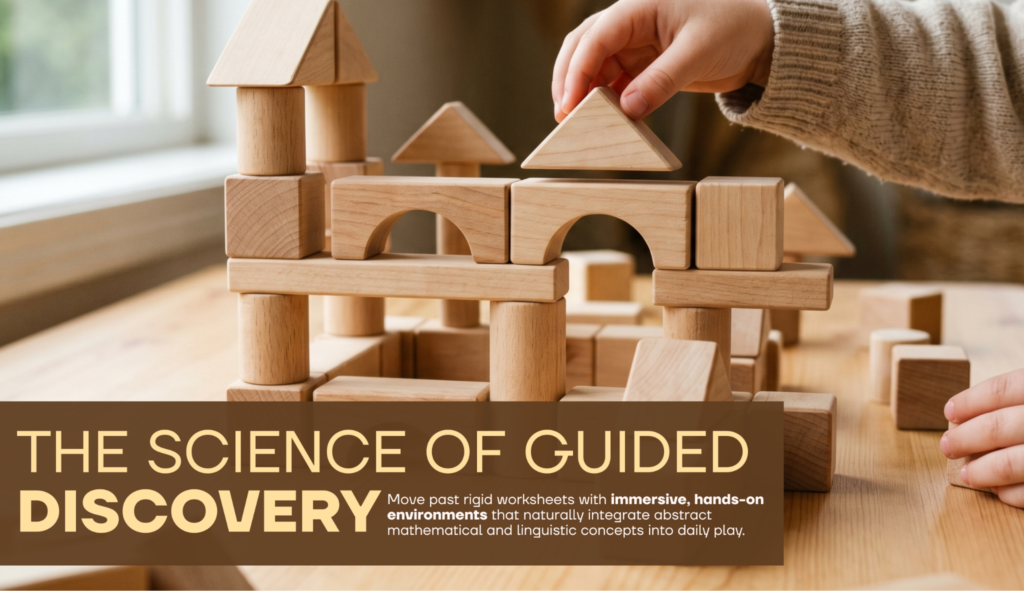
A common misconception among families is the idea that early literacy and numeracy must look like traditional worksheets, rote flashcard memorization, or forced academic drills. Modern early childhood pedagogy proves that young minds absorb abstract mathematical and linguistic concepts best when they are experienced through physical, play-based discovery.
In a premium preschool or long day care setting, mathematical concepts are introduced naturally through everyday play and concrete exploration. For example, a teacher might help children learn about weight, volume, and balance by measuring sand in the outdoor sandpit, or guide them to recognize geometric patterns by building complex blocks of varying sizes. Literacy skills are woven just as naturally into the daily routine through interactive storytelling sessions, rhythm games, and labeling everyday items throughout the classroom. This rich approach to literacy helps toddlers discover that symbols and letters carry meaningful messages, building a rock-solid cognitive foundation without creating the unnecessary stress associated with forced academic performance.

Image from Pexels
Structural Comparison: Traditional Minding vs. NQF-Aligned Early Education
Reviewing the clear differences in daily programming, learning outcomes, and staff engagement between traditional supervision styles and NQF-aligned services demonstrates why structured early childhood education delivers superior developmental results.
- Learning Continuity and Curriculum: Traditional supervision relies on random, unguided free play with minimal tracking, while NQF-aligned services offer a dynamic, child-led curriculum structured around documented developmental milestones.
- Educator Engagement and Interaction: Older models focus simply on basic safety and physical monitoring, whereas modern practices use deliberate scaffolding to expand language skills and stimulate critical thinking during play.
- Mathematical and Linguistic Foundations: Traditional approaches treat learning abstractly through repetitive worksheets, while advanced frameworks embed math and reading concepts into fun, hands-on physical activities.
- Social-Emotional Skill Building: Basic care resolves peer conflicts with simple separation, while premium centers actively teach self-regulation and emotional literacy using research-backed positive guidance techniques.
By understanding these clear operational contrasts, proactive families can easily see that choosing an NQF-aligned early learning center is a highly strategic investment in their child’s long-term academic and social success.
Cultivating Emotional Intelligence and Self-Regulation
While cognitive milestones like language acquisition and spatial reasoning are incredibly important, a child’s social and emotional development serves as the bedrock for all future academic learning. The ability to manage intense emotions, focus attention, and cooperate harmoniously with peers is known collectively as self-regulation, a skill that is heavily wired during early childhood.
Experienced early educators use positive, proactive guidance strategies to help toddlers identify and understand their complex emotions rather than suppressing them. Classrooms are often equipped with peaceful “cozy corners” where a child can voluntarily retreat to reset their nervous system with calming sensory tools when feeling overwhelmed. Through guided group activities and collaborative projects, children practice sharing resources, listening to different perspectives, and learning how to negotiate compromises safely. Developing these strong emotional skills during the toddler years prevents behavioral issues down the road and ensures children enter school with the confidence needed to make friends and face new challenges.
Supporting a Seamless Transition to Formal Schooling
The final phase of the early childhood education journey focuses on preparing older children for a smooth, stress-free transition into their first year of formal school, whether that path leads to Prep, Reception, or Kindergarten. A high-quality preschool or kindergarten program bridges this gap by slowly introducing more structured routines into the day while keeping the core elements of play-based exploration alive.
Educators work closely with families to cultivate essential school-readiness skills, which prioritize independence and active self-help behaviors. Children practice packing their own bags, opening lunchboxes, managing uniform buttons, and following complex multi-step instructions independently. Furthermore, premium centers maintain open lines of communication with local primary schools, sharing detailed transition statements that outline each child’s unique learning style, strengths, and individual needs. This collaborative handoff guarantees that the child’s new school teachers can support their growth from the very first day, ensuring a positive and confident start to their formal academic journey.
Conclusion: Securing a Bright, Confident Cognitive Future
The environment you choose for your child during their first five years will echo throughout their entire academic, professional, and personal life. Relying on basic, unstructured care arrangements can mean missing out on the most active window of brain development your child will ever experience, leaving vital cognitive and emotional potentials unreached.
By stepping into the rich, intentional world of modern NQF-aligned early childhood education, you provide your child with an exceptional foundation for future growth. This comprehensive care strategy ensures that your toddler benefits from high educator ratios, interacts with a play-based curriculum that naturally introduces literacy and numeracy, and builds the strong emotional resilience required for a seamless transition into formal schooling. Take complete command of your child’s early learning journey, select a center that prioritizes advanced developmental science, and watch them step forward into the world as a creative, confident, and joyful life-long learner.
____________________________________________________________________________
Steven Lagrimas is a freelance writer specializing in STEM, business, health, politics, and the social sciences. His work explores the intersection of society, governance, innovation, and emerging global trends shaping communities and industries today.