
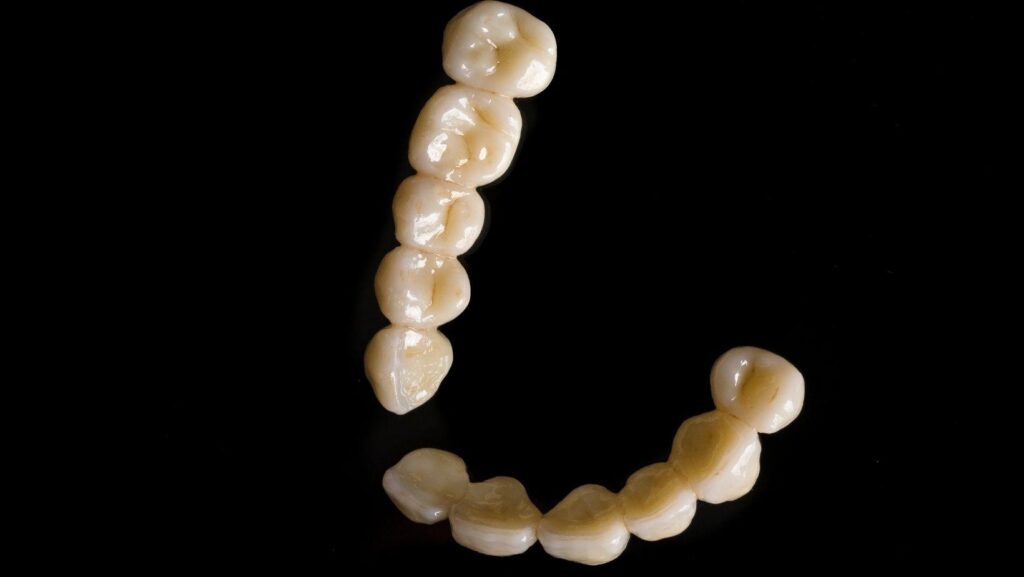
When you choose a full arch restoration, the materials affect appearance, strength, weight, maintenance, and repair options. Acrylic resin, zirconia, and titanium frameworks each serve different purposes.
Your needs, bite, hygiene habits, and budget should guide the decision. Anyone comparing options for full arch dental implants in Minot, ND will want to weigh these material trade-offs carefully, since acrylic can offer a lighter, more repairable, and often more affordable option.
Zirconia provides a strong, wear-resistant tooth structure. Titanium supplies a durable framework beneath the prosthesis.
Understanding how these materials work together helps you compare designs more accurately. You will also learn how core components, acrylic formulations, zirconia prostheses, and titanium framework designs influence comfort, function, and long-term care.
Core Components of Full Arch Prostheses
A full arch prosthesis combines visible replacement teeth and gingival contours with a precisely fitted supporting framework. You must evaluate appearance, wear resistance, hygiene access, load distribution, and repair requirements together when selecting materials.
Prosthetic Teeth and Gingival Materials
Prosthetic teeth commonly use acrylic resin, composite resin, or ceramic materials. Acrylic teeth remain widely used because they are relatively easy to adjust, replace, and repair.
They also provide some resilience, which can help manage occlusal forces, but they may wear, stain, or fracture sooner than denser alternatives. Composite teeth can offer improved surface characteristics and shade control.
Ceramic teeth provide high wear resistance but may transfer greater forces to the prosthesis and opposing dentition. The gingival portion may use pink acrylic, composite resin, or a milled pink ceramic.
Pink acrylic allows you to modify contours and repair chips efficiently, although it can accumulate stains and plaque if its surface becomes rough. You should assess lip support, speech, smile display, hygiene access, and the patient’s ability to maintain the prosthesis before finalizing the gingival material.
Role of the Supporting Framework
The framework connects the prosthesis to the implants and distributes chewing forces across the implant positions. Titanium offers high strength, low weight, corrosion resistance, and predictable long-term use.
Its favorable elasticity can help reduce stress concentration compared with stiffer materials, but accurate passive fit remains essential because machining or processing errors can overload implants and components. Zirconia provides tooth-colored esthetics and high rigidity.
Monolithic zirconia can reduce veneering-related chipping, while layered designs may offer more natural characterization but introduce an additional veneer interface. Zirconia frameworks can show higher strain concentrations in some studies, so you should consider implant distribution, cantilever length, occlusion, framework thickness, and connector design.
Acrylic-and-titanium designs simplify repairs and replacement of worn teeth. You should select the framework material through coordinated implant planning, digital or laboratory verification of fit, and careful control of occlusal contacts.
Acrylic Resin Options
Acrylic resin offers a cost-conscious, repairable option for full-arch implant restorations, especially during immediate loading and provisional stages. You should balance its lower fracture resistance and greater maintenance needs against easier adjustments, lighter weight, and straightforward replacement.
Benefits and Limitations
You can use acrylic teeth on a titanium framework to create a hybrid prosthesis. This design usually costs less than a definitive monolithic zirconia restoration, weighs relatively little, and allows your clinician to adjust tooth position, occlusion, and esthetics more easily.
Acrylic also supports efficient provisionalization after implant placement because the laboratory can modify or replace teeth without remaking an entire rigid ceramic structure. Acrylic resin remains more vulnerable to wear, staining, chipping, and fracture than zirconia.
Repeated heavy loading, limited restorative space, poor occlusion, or parafunctional habits such as bruxism can accelerate damage. Your clinician should verify implant distribution, framework fit, occlusion, and hygiene access before delivery.
A well-designed titanium framework supports the prosthesis and reduces flexure compared with unsupported acrylic.
Maintenance and Repair Considerations
You should expect periodic maintenance rather than treating an acrylic hybrid as maintenance-free. Common services include replacing worn or fractured denture teeth, repairing acrylic around the framework, adjusting the bite, and replacing screws or other prosthetic components when indicated.
Your dental team may also need to reline or remake the prosthesis if tissue contours change or hygiene access becomes inadequate. Daily cleaning requires a soft brush, nonabrasive products, and devices recommended for your specific implant design.
Avoid using hot water, which can distort acrylic, and do not use abrasive toothpaste that can roughen its surface. Attend regular examinations so your clinician can check screw stability, framework fit, tissue health, occlusion, and wear.
Address looseness, clicking, cracks, bleeding, or difficulty cleaning promptly.
Zirconia Prostheses
Zirconia provides a tooth-colored, ceramic option for full-arch implant restorations. You can use it to prioritize rigidity, stain resistance, and soft-tissue compatibility, but you must plan the design carefully because repairs and adjustments can be more difficult than with acrylic.
Strength, Esthetics, and Wear Resistance
Monolithic zirconia offers high fracture resistance and eliminates the veneering porcelain layer that can chip in layered restorations. Its dense surface resists staining and plaque retention, while modern translucencies can produce a more natural appearance than earlier opaque zirconia materials.
Zirconia does not absorb water or discolor like acrylic. However, its hardness can increase wear on opposing natural teeth or restorations when you use poorly adjusted occlusion, excessive surface roughness, or inadequate polishing.
You should verify contacts carefully and polish any adjusted areas according to the manufacturer’s instructions. Implant position, cantilever length, prosthesis fit, occlusal forces, and parafunctional habits influence the result.
You should also discuss the limited chairside repair options before choosing zirconia.
Design Considerations for Monolithic Zirconia
You should design monolithic zirconia with adequate connector dimensions, rounded internal contours, and smooth transitions that reduce stress concentration. Avoid sharp internal angles, thin extensions, and unnecessarily long cantilevers.
The laboratory must account for implant angulation, prosthetic space, hygiene access, and the position of the screw-access channels. A zirconia restoration can use a titanium interface or a compatible base that connects the ceramic prosthesis to the implant components.
This design can protect the ceramic connection from concentrated stresses and support retrievability, but it requires accurate milling, bonding, and torque control. You should establish the occlusal scheme before fabrication.
Provide even centric contacts, limit damaging excursive interferences, and consider a night guard for patients with bruxism. Maintain adequate space for material thickness without compromising phonetics, lip support, or cleansability.
Titanium Framework Designs
Titanium frameworks provide a rigid, lightweight substructure that connects the implants and supports the prosthetic teeth. Your design must balance passive fit, cleanability, space for restorative materials, and access for maintenance.
Framework Function and Passive Fit
A titanium framework distributes chewing forces across the implants and limits flexure beneath the prosthetic teeth. You typically fabricate it by milling or machining the framework from a titanium block, which supports accurate implant-connection geometry and consistent thickness.
Passive fit matters because a framework that binds during seating can introduce strain into screws, abutments, and implants. You should verify the fit clinically with methods such as the one-screw test, radiographic assessment, and confirmation that each prosthetic screw seats without resistance.
The framework design also needs adequate clearance for hygiene access, screw channels, tooth arrangement, and the selected veneering material. You should avoid unsupported extensions and excessive cantilevers.
Their length and position depend on implant distribution, occlusion, arch form, and the framework’s cross-sectional dimensions. Your laboratory and clinician should evaluate these factors together rather than relying on a single universal design ratio.
Hybrid Material Combinations
A common design pairs a titanium framework with acrylic resin teeth and a denture-base material. This combination reduces weight and allows chairside or laboratory repairs.
It is relatively simple to replace worn or fractured teeth. Acrylic also permits adjustments to occlusion and tooth position.
The main limitation involves material maintenance. Acrylic teeth and resin bases can wear, fracture, stain, or detach from the framework, particularly when there is limited restorative space, unfavorable loading, or parafunctional activity.
The framework should include mechanical retention features, such as beads, vents, or designed undercuts, to secure the resin without compromising hygiene contours.
You can also combine titanium with zirconia or another ceramic suprastructure. This approach may improve wear resistance and esthetics.
It requires careful control of connector dimensions, bonding or luting procedures, occlusal contacts, and repair strategy.