
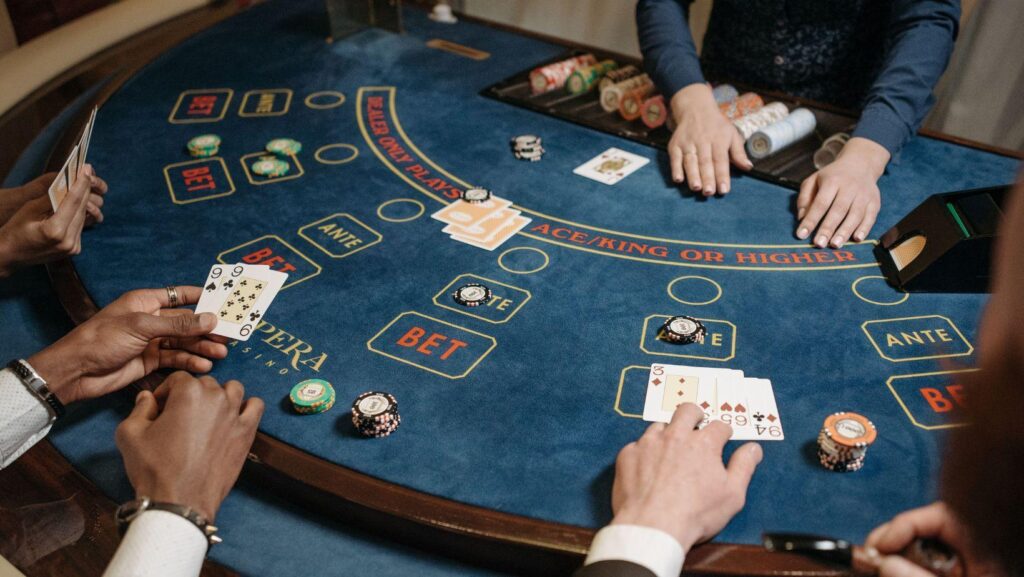
Something happens around a blackjack, roulette, or craps table that slot machines rarely capture: several players follow the same action, watch the same cards, ball, or dice, and react together to the outcome. This shared experience sets table games apart from much of what a casino offers and helps explain why some players prefer the atmosphere around a table to playing alone.
Every Table Game Has Its Own Rhythm
Roulette follows a straightforward cycle: players place their bets, the ball spins, and the outcome is decided when it settles into a numbered pocket.
Blackjack unfolds differently. Each player takes a turn deciding whether to hit, stand, double down, or split a pair when the rules allow it. These decisions give each hand a more measured pace, allowing players and spectators to follow the action around the table.
Craps has a rhythm of its own. Play revolves around a series of dice rolls by the same shooter, with different bets remaining in play, being resolved, or changing from one roll to the next.
Understanding these differences before joining a table helps players know what to expect. Following a roulette spin is a different experience from watching a blackjack hand or keeping track of the bets on a craps table.
Posted Rules Help Players Understand the Game
What might seem like a minor table convention—such as whether the dealer hits or stands on a soft 17 in blackjack—is actually an important part of the game’s rules.
In Ontario, standards set by the Alcohol and Gaming Commission of Ontario require certain game-specific options to be displayed at the table. For blackjack, these include an indication of whether the dealer stands on all totals of 17 or hits on a soft 17.
These rules affect how a hand unfolds, so players should check them before placing a bet.
The standards also cover equipment and operating procedures, including the identification of cards and chips and the information displayed at the table, to support oversight and monitoring.
For players, the principle is straightforward: the conditions of play should be available to check, rather than left to guesswork.
Poker Brings a Different Kind of Strategy
Poker stands out because, in games played against other players, decisions involve more than responding to a fixed set of dealer rules.
In Texas Hold’em, for example, players decide when to bet, call, raise, or fold based on their own cards, the community cards, the size of the bets, and their opponents’ actions.
Chance determines which cards are dealt, but the choices players make throughout a hand shape how it develops.
This combination of chance, incomplete information, and successive decisions gives poker a distinctive place among table games. It also makes a hand engaging to watch: each action offers a clue, while much of the information remains hidden.
For anyone looking to understand the betting rounds, hand rankings, and flow of a typical hand, this guide explains the basics of playing poker in a casino before taking a seat.
Choosing an Online Table Starts with Comparing Platforms
Many familiar table games are also available online, but the selection varies from one platform to another.
Differences can include betting limits, available variants, table rules, game providers, and the terms attached to promotional offers.
For Canadian players, a comparison of casinos en ligne au Canada can provide a starting point for reviewing platforms, bonuses, payment methods, and game selections before deciding where to register.
Checking these details in advance can help players avoid opening an account only to discover that their preferred option—such as classic blackjack, European roulette, live dealer tables, or a particular poker format—is unavailable.
Players should still confirm the current selection, rules, and terms directly with the operator before depositing or betting, as these can change.
The Social Appeal Comes from the Action Around the Table
Much of the appeal of table games comes from what happens around the outcome.
At a craps table, several players may celebrate or react to the same roll. In blackjack, players and spectators can follow each participant’s decisions before watching the dealer complete the hand. In poker, a raise can instantly change the mood and force everyone still involved to reconsider their next move.
These moments create a shared rhythm that is less common in games played alone.
Clear rules make that interaction possible. They give everyone a common framework: when to act, which choices are available, and how the outcome is decided.
That blend of rules, chance, decisions, and collective reactions is what gives table games their distinctive atmosphere—whether you are watching from the sidelines or taking a seat yourself.