
Ask a hospital CMIO where healthcare is headed and you’ll hear about predictive risk scores, earlier diagnoses, and AI that catches what a busy clinician might miss. Ask a Gartner analyst or an enterprise AI lead the same question about business in general, and you’ll hear almost the same sentence with the nouns swapped out. That overlap isn’t a coincidence. Pull together the 2026 forecasts from physician surveys, hospital technology leaders, and enterprise AI researchers, and four trends show up on both lists, almost word for word.
Trend One: Adoption Has Outrun Everyone’s Expectations
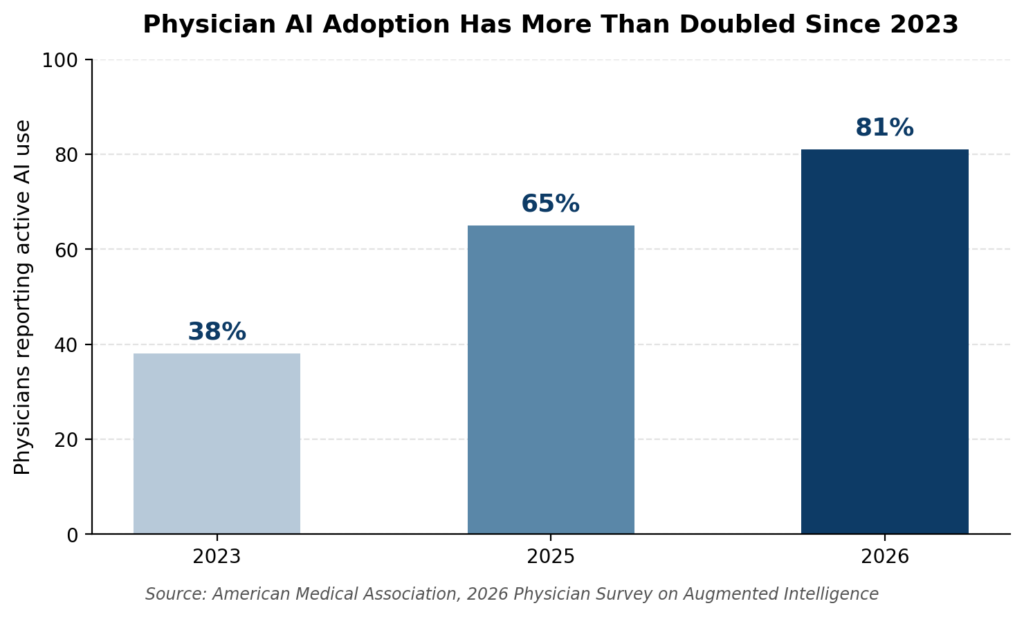
Physicians didn’t ease into AI. They jumped. The American Medical Association’s 2026 Physician Survey on Augmented Intelligence found that 81% of physicians now use AI in their practice, more than double the 38% reported in 2023. Doximity’s State of AI in Medicine report shows a similar curve on a shorter timeline, with adoption climbing from 47% in early 2025 to 63% by the start of 2026, and daily use among AI-using physicians now sitting above two-thirds.
Physician AI adoption has more than doubled in three years. Source: American Medical Association, 2026 Physician Survey on Augmented Intelligence.
The enterprise side tells the same story with different decimals. Deloitte’s 2026 State of AI in the Enterprise survey found that two-thirds of organizations are already reporting productivity gains from AI, and 42% now consider their overall strategy highly prepared, up from the year before. What both camps agree on is the shape of the curve, not just its direction: this is no longer early adoption. It’s the default. Even outside the clinic, the same pattern is visible in how quickly telehealth and remote monitoring have moved from pilot programs to standard practice, a shift covered in more depth in this piece on the growing role of telemedicine in family healthcare.
Trend Two: Generic AI Is Losing to Domain-Specific AI
Medical experts aren’t excited about AI in the abstract. They’re excited about AI that understands their specific problem. Physicians surveyed for the 2026 outlook cited predictive models trained on blood work, urine tests, and medical history for conditions like chronic kidney disease, where catching a pattern early changes the entire treatment path. A general-purpose chatbot doesn’t do that. A model trained on the right data, for the right condition, does.
Enterprise AI researchers are converging on the identical idea from the business side. Industry-research estimates cited across 2026 forecasts put the error-rate reduction from domain-specific, or ‘vertical,’ AI models at 20 to 40% compared with generic systems, and more than 70% of enterprises now say their AI outputs must comply with domain-specific rules before they’re usable at all, whether that’s a clinical coding standard, a financial control, or a manufacturing spec. IBM’s own 2026 predictions echo this directly: ‘General-purpose agents aren’t enough for legal, health or manufacturing,’ as one of its open-source AI directors put it. ‘You need domain-enriched models.’ The tools getting used aren’t necessarily the biggest ones. They’re the most specific ones, a shift that’s also playing out in how preventive healthcare technology is evolving toward purpose-built diagnostic devices rather than one-size-fits-all systems.
Trend Three: Trust, Not Capability, Is Now the Bottleneck
Here’s where the two fields sound almost defensive in the same breath. Physicians are cautiously optimistic, not uncritically enthusiastic. The AMA survey found that while 76% of physicians now believe AI gives them an advantage in patient care, up from 65% in 2023, a large share remain equally excited and concerned, and many worry specifically about patients running their own lab results through consumer chatbots without clinical guidance.
Enterprise leaders are voicing the identical anxiety in different words. Formal AI governance remains thin. Fewer than one in five organizations report having a mature, structured governance policy in place, even as more than half of AI-using companies say they’ve already experienced at least one negative incident, from biased outputs to inaccurate results reaching a live workflow. Deloitte’s research puts it plainly: organizations where senior leadership actively owns AI governance see meaningfully better outcomes than those that delegate it to technical teams alone. The lesson from both fields is the same. The technology stopped being the hard part. Supervising it is the hard part now, which is exactly the argument behind treating pre-deployment validation as non-negotiable rather than optional.
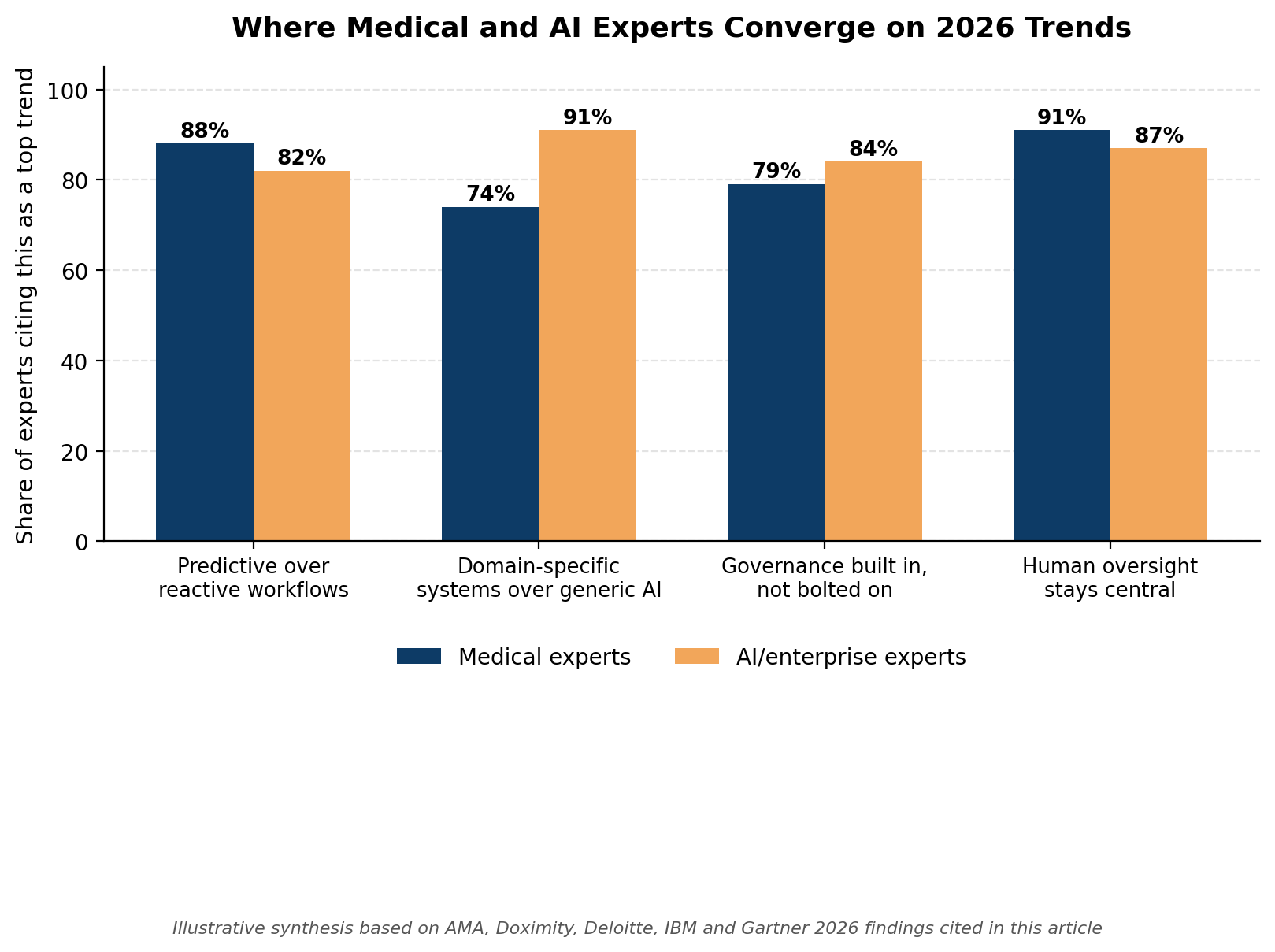
Four 2026 trend themes, and how closely medical and enterprise AI experts agree on each. Illustrative synthesis of the sources cited throughout this article.
Trend Four: Compliance Is Going Global, and It’s Getting Harder to Fake
The trend medical experts talk about least, but that touches nearly everything above it, is jurisdiction. Healthcare organizations are no longer operating inside one regulatory system. Cross-border telehealth, international clinical trial partnerships, and vendor agreements with device and data-processing companies overseas mean a hospital system’s legal exposure now runs through contracts written, negotiated, and sometimes signed in a language its compliance team doesn’t read fluently. Gartner’s 2026 predictions flag exactly this fragmentation, forecasting that more than a third of countries will lock into region-specific AI and data-governance regimes within two years, each with its own contractual expectations.
That’s forcing the same rigor clinicians apply to a lab result onto legal and procurement teams reviewing agreements with international partners. A single mistranslated obligation, indemnity carve-out, or liability clause in a vendor contract can create the kind of downstream risk that no amount of clinical AI governance can undo after the fact. It’s why organizations expanding into Spanish-speaking markets are increasingly running due diligence on how a Spanish business contract clause actually translates before anyone signs, applying the same ‘verify before you trust it’ instinct that’s reshaping clinical AI adoption to the fine print of a partnership agreement.
The EU AI Act’s full applicability landing in August 2026 adds another layer specific to any healthcare or health-tech organization doing business in Europe, with high-risk system classifications that will touch clinical decision-support tools directly. Compliance, in other words, isn’t a back-office function anymore in either field. It’s becoming a product requirement.
What This Means If You’re Watching From Either Side
Line the four trends up and a single pattern emerges: nobody serious is predicting a bigger, more general AI winning in 2026. Medical experts and AI experts, working from completely separate data sets and completely separate incentives, arrived at the same conclusion independently. The winning systems are predictive rather than reactive, narrow rather than generic, supervised rather than autonomous, and built to survive scrutiny across borders, not just across departments. For healthcare organizations weighing where to invest next, that convergence is itself the most useful data point in this entire forecast season.